- «Home
- «Research |
- Knowledge Gaps
Knowledge Gaps
Sixteen years on In 2004, when Ozcranes began, many often-repeated ‘facts’ about Australian Sarus Cranes were still just interesting hypotheses waiting to be investigated, and some were apparently myths waiting to die, despite evidence to the contrary!
Today, knowledge has greatly increased on Brolgas and Australian Sarus Cranes, but there are still major gaps in our knowledge of crane ecology and behaviour. Here we note some gaps (from the species FAQS and other Ozcranes pages); and also recommendations for future work from recent published papers.
Knowledge gaps from FAQs
For the full FAQs for Brolgas and Australian Sarus Cranes, see the Ozcranes Site Map. FAQs include features, locations, numbers, food and water, breeding, non-breeding habitats and behaviour, and conservation. As well, there are individual pages covering e.g. Brolgas in New Guinea. This list covers just some knowledge gaps highlighted on Ozcranes:
- Nests and eggs of Australian Sarus Cranes are virtually unknown; many features such as incubation period and clutch size are based on overseas data
- Nests and eggs of the northern Brolga population, and breeding sites and habitats for the large Top End population, are unknown
- Diet studes for both species Australia wide are minimal. Brolgas can tolerate saline water with a special gland, but no study has measured salinity in water and foods they actually use
- Almost nothing is known about Brolgas in New Guinea, including whether they migrate within New Guinea or to Australia. Significant conservation threats may exist
- Sarus Crane breeding is suspected on eastern Cape York Peninsula but not proven
- Movements of large numbers of Brolgas in response to arid region rains and droughts are not known
- Current status of breeding Brolgas in the Townsville/Ayr region (previously important) is unknown
- The proportion of Australia's Sarus Cranes that remain in the Gulf and on Cape York during the dry, non-breeding season is unknown (and the proportion wintering on the Atherton Tablelands is unknown)
 TOP
TOP
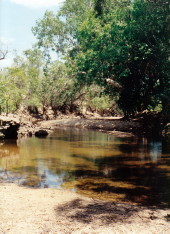
↑ Wetland, Gulf Plains: Sarus breeding habitat (K.S. Gopi Sundar)
Research papers
Recent research papers are listed (with links) at Ozcranes Current Research home». Research papers since 2018 have expanded knowledge on aspects of Brolga and Sarus Crane biology and ecology in Australia, here we look at the areas recommended or implied, for future research and conservation.
Wintering (non-breeding) Brolgas and Sarus Cranes, Atherton Tablelands
Recommendations from recent papers:
- If changed land use deters cranes from wintering on the Tablelands, consider food supplementation combined with tourism (assumes wintering on the Tablelands is important to maintain crane populations in the region)
- If crane damage to crops incites persecution from farmers, consider farmer subsidies or crop repellents
- Continue annual Crane Counts, consider use of advanced optics to improve identification to species
- Investigate roosting behaviour of Brolgas and Sarus Cranes, including (1) the rare behaviour of mingling (rather than occupying separate areas) at mixed roosts (2) the later arrival of Sarus Cranes at roosts
Nevard Timothy D., Leiper Ian, Archibald George, Garnett Stephen T. 2018. Farming and cranes on the Atherton Tablelands, Australia. Pacific Conservation Biology 25: 184-192.
Nevard Timothy D., Franklin Donald C., Leiper Ian, Archibald George, Garnett Stephen T. 2019. Agriculture, brolgas and Australian sarus cranes on the Atherton Tablelands, Australia. Pacific Conservation Biology 25: 377-385.
Elinor C Scambler, Timothy D Nevard, Graham N Harrington, E. Ceinwen Edwards, Virginia Simmonds, Donald C Franklin. 2020. Numbers, distribution and behaviour of Australian Sarus Cranes Antigone antigone gillae and Brolgas A. rubicunda at wintering roosts on the Atherton Tablelands, far north Queensland, Australia. Australian Field Ornithology 37: 87-99.
Elinor C Scambler. 2020. Jim Bravery's cranes: Brolgas and Sarus Cranes on the Atherton Tablelands, 1920-1975. North Queensland Naturalist 50: 12-24.
Breeding Brolgas and Sarus Cranes, Gulf Plains (GP) and Victoria (V)
Recommendations from recent papers:
- (GP) Surveys of crane breeding habitat in the Gulf Plains should be extended to cover multiple wetland types including more coastal areas
- (GP) Development plans for the region should recognise and factor in, the importance of critical Regional Ecosystems and water flows to crane breeding wetlands
- (GP) Further study to determine diets of Brolgas and Sarus Cranes in other locations and seasons
- (V) Management of breeding habitat for the Vulnerable southern Brolga population should focus on wetland complexes, not single wetlands
- (V) Created or modified wetlands should incorporate at least three wetlands close to each other, and movement corridors in territories
- (V) Further GPS tracking should follow adults, not just young, through the whole breeding season, and review buffers from wind towers
K. S. Gopi Sundar, John D. A. Grant, Inka Veltheim, Swati Kittur, Kate Brandis, Michael A. McCarthy and Elinor C. Scambler. 2019 Sympatric cranes in northern Australia: abundance, breeding success, habitat preference and diet, Emu 119: 79-89
Veltheim, Inka, Simon Cook, Grant Palmer, Richard Hill, and Michael McCarthy 2019. Breeding Home Range Movements of Pre-Fledged Brolga Chicks, Antigone rubicunda (Gruidae) in Victoria, Australia – Implications for Wind Farm Planning and Conservation. Global Ecology and Conservation (e00703).

↑ Brolgas and Sarus mingling at roost, Mareeba Wetlands (now Tropical Wetlands SER, Forever Wild), Atherton Tablelands, Queensland (Tim Nevard). Such mingling at mixed-species wintering roosts is rare and not yet well understood
Population genetics & hybrids
Recommendations from recent papers:
- Findings that the Australian Sarus Crane is a defined sub-species should be factored into conservation planning; migration of crane populations within Australia should be factored into conservation planning
- Analysis of sub-species relationships in the Sarus Crane would be improved by more material from the extinct Philippine population
- Hybridisation should be further investigated using visual and genetic analysis of moulted feather samples (deeper insights would require catching many more cranes for blood and tissue samples)
- Migration patterns and trends in northern Brolgas and Sarus Cranes should be further investigated with systematic collection of feather samples for analysis
- Genetic differences between northern and southern Brolga populations should be investigated using more locations and replicate samples
Nevard, Timothy D., Martin Haase, George Archibald, Ian Leiper, and Stephen T. Garnett. 2020. The Sarolga: Conservation Implications of Genetic and Visual Evidence for Hybridization between the Brolga Antigone rubicunda and the Australian Sarus Crane Antigone antigone gillae. Oryx 54: 40-51.
Nevard TD, Haase M, Archibald G, Leiper I, Van Zalinge RN, Purchikoon N, Siriaroonrat B, Latt TN, Wink M and Garnett ST. 2020. Subspecies in the Sarus Crane Antigone antigone revisited; with particular reference to the Australian population. PLOS ONE https://doi.org/10.1371/journal.pone.0230150.
Adam D Miller, Inka Veltheim, Timothy Nevard, Han Ming Gan and Martin Haase 2019, Microsatellite loci and the complete mitochondrial DNA sequence characterised through next-generation sequencing and de novo genome assembly, and a preliminary assessment of population genetic structure for the Australian crane, Antigone rubicunda. Avian Biology Research 12(2).